Researched 2026-10-21 · Seasonal opportunity
What Should A Winter Puffer Jacket Fill Specification Include?
A club winter-jacket order needs more than a fill-power number. Purchasing teams should separate the insulation material, quantity, test evidence and sourcing claim before comparing prices or approving a branded sample.
Quick Answer
What Should Multi-sport outerwear Buyers Know?
Specify the filling composition, fill-power test method and units, filling weight by garment size, and distribution across the body, sleeves and hood. Keep sourcing certification separate from performance evidence. Approve those records against an identified construction sample before releasing a winter puffer order.
Multi-sport outerwear research
Fill power describes a test result, not the entire jacket
IDFL describes fill power as the volume occupied by a specified quantity of down under a specified load. Its testing page treats composition analysis separately: that analysis reports the filling components by weight. These are different measurements, not interchangeable descriptions of jacket quality.
For a purchasing comparison, record composition and fill power in separate fields. Also request the filling mass in grams for each garment size. A number attached to a style name does not establish how much insulation is supplied in the jacket, nor does it replace a report tied to the proposed material.
Evidence: IDFL
Multi-sport outerwear research
Compare reports on the same conditioning basis
IDFL's conditioning guidance explains that converting between measuring systems does not account for differences in conditioning. It advises testing to the specific method rather than treating a numerical conversion as equivalent evidence. The preparation of the sample therefore belongs beside the result in a buyer's comparison.
Ask the laboratory or supplier to identify the method, conditioning procedure, reporting units and sample reference. Where two quotations use different methods, flag the comparison as unresolved. Do not silently rank the higher number first or rewrite the supplier's result into a preferred unit without confirming comparability.
Evidence: IDFL
Multi-sport outerwear research
Sourcing certification answers a separate question
Textile Exchange describes the Responsible Down Standard as a voluntary animal-welfare and chain-of-custody standard. Its current page says down is not included in the first Materials Matter Standard version and that companies can continue using RDS under its claims policy. This was checked on 21 October 2026.
If the order requires an RDS claim, make that a documented sourcing requirement before approving labels. Do not infer certification from a down description or use a certification mark as decoration. This article does not assert that Olinc Sports or the illustrated jacket holds RDS certification; the requested supply route and claim eligibility need confirmation.
Evidence: Textile Exchange
Multi-sport outerwear research
Build a size-by-size filling schedule
The following is a proposed buying workflow, not a laboratory standard. Create one row per size with columns for total filling mass, body allocation, sleeve allocation, hood allocation where relevant, and the supplier's proposed tolerances. Identify whether those figures describe the approved sample or a production target. Leave unresolved fields visibly open rather than copying the medium-size figure across the range.
Ask the supplier to explain how the filling schedule changes with the pattern. If the buyer later extends the hem, adds a hood or changes the baffle layout, reopen the filling schedule as part of that revision. Record who approved the new allocation and which sample demonstrates it. This makes an apparently small styling change visible to purchasing, sampling and production staff.
Include a separate quotation line for any alternative insulation route. A synthetic-filled option should arrive with its own material specification and sample approval record; it should not inherit the down option's description. The buyer can then compare two defined proposals instead of receiving a substitution hidden behind the same style code.
Multi-sport outerwear research
Approve construction around the intended winter use
Write down who will wear the jacket and when: coaching at the touchline, travelling with a squad, or wearing club merchandise away from training. List the intended underlayers and ask representative wearers to check reach, sitting, fastening and pocket access. Record observations against the sample size and pattern revision. Do not turn a brief fitting session into a promised temperature rating.
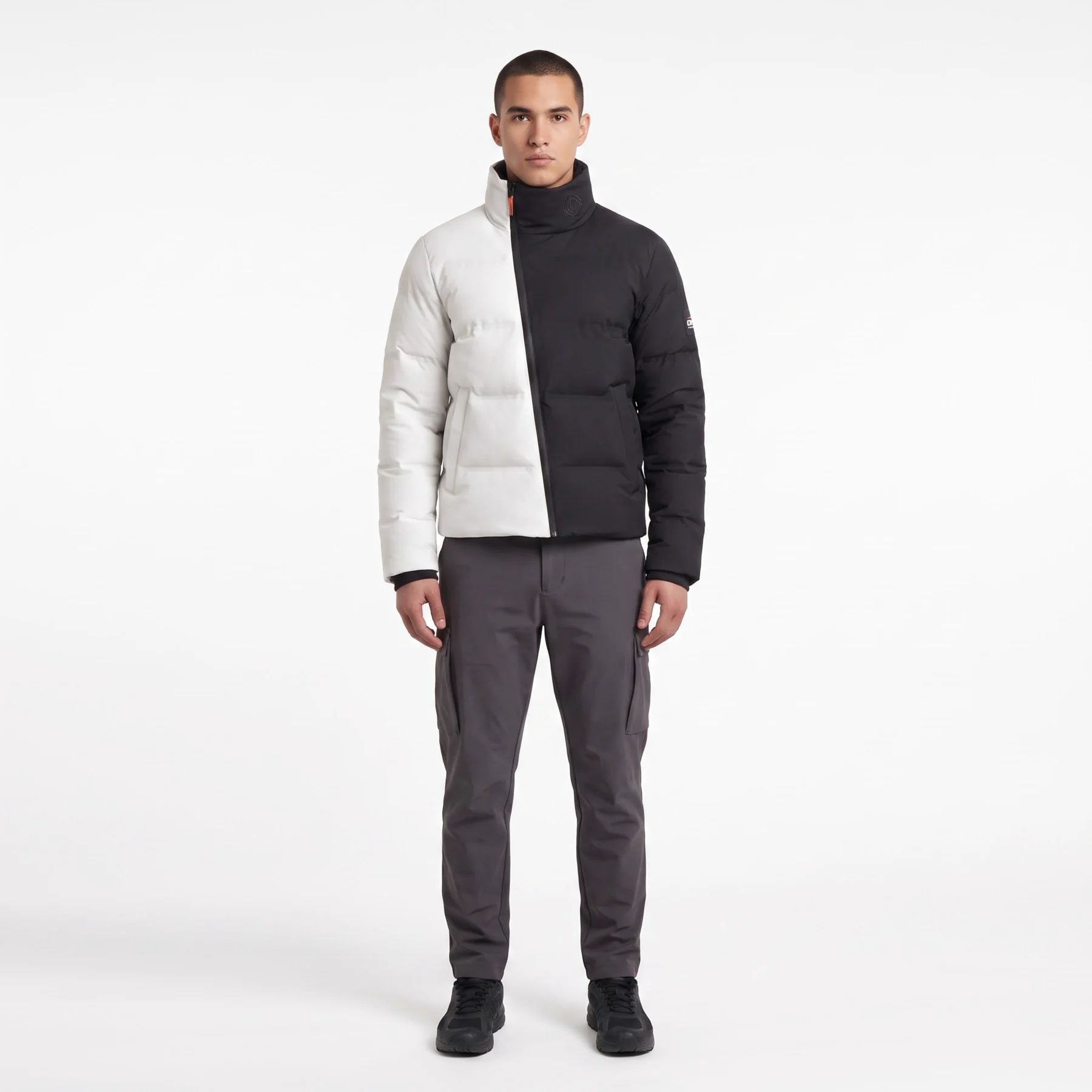
For a welded design, request a marked baffle drawing and a sample that uses the proposed shell and joining route. Review channel alignment, closure access and the placement of the crest with the supplier. Agree how any embroidery, badge or other decoration will be incorporated before filling and final assembly. A logo position on a flat artwork file is not approval of the finished jacket construction.
Treat a catalog page as the starting point for that discussion. The Olinc sonic-welded puffer page explicitly asks buyers to confirm composition, sourcing, fill weight and testing. Its 800-fill style name is not independent verification of a particular shipment. Request evidence for the actual proposal instead of carrying the title unchanged into a purchase specification.
Multi-sport outerwear research
Make the sample release usable for purchasing and packing
Issue a single approval record linking the jacket style, pattern revision, insulation description, filling schedule, test-report reference and decoration proof. Mark whether an approval is visual only, fit only or a complete production release. If evidence is still pending, identify the owner and the decision that cannot proceed. This avoids a photograph being mistaken for permission to begin the entire order.
Ask for the proposed fold method, packing arrangement and any compression limits to be included in the sample discussion. Request an agreed unpacking inspection process for the receiving team, with photographs and a clear route for reporting concerns. Set those checks before dispatch rather than improvising a dispute procedure when cartons arrive.
For an Olinc quotation, send quantities by size, destination, required arrival date, intended winter use and the completed insulation fields through the site's email or WhatsApp quote route. Ask which sample and evidence steps must be completed before a delivery schedule can be confirmed. Keep freight assumptions and approval dates visible; this guide does not promise a standard production lead time.
Buyer checklist
Turn The Research Into A Quote Brief.
01
02
03
Buyer FAQs
Questions To Resolve Before Production.
Is a higher fill-power number enough to choose a club jacket?
No. Keep the reported result separate from filling quantity, construction, fit and intended use. Ask for a comparable test basis and a completed garment proposal before choosing between quotations.
Should every jacket size have the same filling weight?
Do not assume that. Request the supplier's size-level filling schedule and proposed tolerances, then approve it against the pattern and sample set. This guide does not prescribe a universal weight or grading increment.
Can we add an RDS logo because the jacket contains down?
No. A down description alone does not establish eligibility for a certification claim. Confirm the documented sourcing route and applicable claim requirements before label artwork is released.
Research record
Sources Checked On 2026-10-21.
Dates, rules, schedules and technical statements can change. Open the cited first-party source before using a time-sensitive detail for travel, competition or purchasing decisions.
- Down and Feather Testing — IDFL (primary; accessed 2026-10-21).
- Conditioning Methods Evaluation — IDFL (primary; accessed 2026-10-21).
- Responsible Down Standard — Textile Exchange (official; accessed 2026-10-21).