Researched 2026-08-01 · Basketball rules and buyer planning
Reversible Or Separate Basketball Uniforms? A Buyer Guide
A reversible jersey may give a team two colour faces, but that does not automatically make it a compliant substitute for two competition sets. Buyers need to map light and dark colours, number contrast, garment cut and approval samples to the rules that govern their league.
Quick Answer
What Should Basketball Buyers Know?
Choose the governing competition before choosing the garment format. Current FIBA rules require teams to have at least two sets of shirts and assign light and dark roles, so a buyer should not assume that one reversible garment counts as two sets without written confirmation from the competition authority. NFHS rules use white home and dark visitor uniforms with detailed torso and number requirements. NCAA guidelines add neutral-zone and contrast controls, while the NCAA women's rules now permit jerseys designed to be worn untucked. Separate home and away match sets are the clearest specification when rules are strict; reversible garments can be useful for training or other approved uses. For competitions beginning on or after 1 October 2026, check the new FIBA rules before final artwork and samples because that edition is not yet the current rulebook on this article's research date.
Basketball research
Start With The Rulebook, Not The Reversible Feature
FIBA's current 2024 rules say each team must have at least two sets of shirts. They also establish the usual colour arrangement: the first team named in the schedule, normally the home team, wears light shirts, preferably white, while the second team wears dark shirts. The teams may exchange those colours if they agree. That wording matters because a reversible jersey has two wearable faces, but it is still one physical garment. The rule does not state that one reversible shirt satisfies the requirement for two sets.
A buyer working under FIBA rules should therefore ask the federation, league or event organizer a precise question before ordering: will one reversible garment be accepted as the required two shirt sets? Keep the written response with the purchase brief. If there is no confirmation, specify separate light and dark match sets and treat reversible garments as a training, scrimmage or explicitly approved option. This is a buyer-risk decision, not a claim that every competition rejects reversible kits. Local competition regulations can add requirements beyond the base rulebook.
Evidence: International Basketball Federation · International Basketball Federation
Basketball research
Map NFHS Light And Dark Requirements Before Artwork
NFHS guidance for US high-school basketball uses a white home uniform and a dark visiting uniform. Its uniform reference also says the torso must be a single solid colour; gray is permitted only for the away uniform and must meet the stated contrast relationship to black. The front number must be at least four inches high with a stroke at least three-quarters of an inch wide. These are layout controls that need to be built into the artwork template before a buyer approves patterns, side panels, team names or sponsor positions.
The NFHS 2026-27 points of emphasis reinforces the traditional white-home and dark-visitor arrangement and asks that uniforms be worn as intended. It states that jerseys designed to be tucked should be tucked. For a school programme, separate match sets make the colour role obvious and let each torso and number layout be reviewed on its final base colour. If a reversible style is being considered, approve both faces as independent visual layouts and ask the state association or competition administrator whether the garment construction is accepted.
Evidence: National Federation of State High School Associations · National Federation of State High School Associations
Basketball research
Do Not Use One Generic NCAA Artwork Template
The NCAA men's basketball page identifies the 2025-26 rulebook and links official uniform guidance. That guidance defines a neutral zone on the jersey, limits tonal variation in that zone and requires the number to be one solid colour that contrasts with it. It also connects the perceptible majority colour of the shorts to the jersey neutral zone. A design may look sufficiently different on a screen yet still fail the prescribed colour zones or number treatment, so buyers should request a rule-overlay proof in addition to a normal presentation mockup.
The women's game also needs its own current check. NCAA changes effective for the 2025-26 season removed the requirement that women's game jerseys be tucked in because shorter jerseys are being designed to be worn untucked. That does not turn every cut into an approved untucked design, and it should not be copied into a men's specification. Put the sport, division, team category, season and governing document on the tech pack. Then identify the intended jersey length and tuck treatment before grading the size range or placing lower-front artwork.
Evidence: National Collegiate Athletic Association · National Collegiate Athletic Association · National Collegiate Athletic Association
Basketball research
Plan Now For The FIBA Change On 1 October 2026
FIBA has published a 2026 rule-changes document that becomes valid on 1 October 2026. Its updated Article 4.3.1 says shirts must have the same dominant colour on the front and back as the shorts, shirts with sleeves must end above the elbow, long-sleeved shirts are not permitted, shirts must be tucked in, and all-in-one uniforms are permitted. It also says shorts must have the same dominant colour on the front and back, finish above the knee and match the shirt's dominant colour. These are future-effective requirements on the research date, not the rules to label as current before October.
For orders intended for competitions after that date, add a rule-confirmation milestone before final artwork and the approved sample. Ask which FIBA edition and competition regulations will apply on the first match date. Then show the dominant shirt and shorts colours on the same colourway sheet, identify whether the cut is sleeved or sleeveless, and record intended lengths on the measurement chart. If the order spans seasons, do not release all colourways from an older sample until the buyer confirms that the new rule set has been checked.
Evidence: International Basketball Federation
Basketball research
Approve Both Colourways As Production Products
Whether the order uses separate sets or an accepted reversible construction, give each visible colourway its own artwork page. Record the base colour, number colour and outline, team name, crest, sponsor marks, panel boundaries, shorts relationship and player-number list. For a reversible item, identify face A and face B and test the physical sample for opacity, edge exposure, seam appearance, label placement and comfort in both orientations. Those checks are production controls; the governing rules do not guarantee that a particular fabric or construction will perform correctly.
Build the purchase list from players and usage rather than multiplying one headline quantity. State the roster count, spare garments, goalkeeper or special-role needs if the competition has any, staff items, replacement-number plan and whether shorts reverse with the jersey. Separate match sets need clear light/dark SKU labels and packing. Reversible products need equally clear face identification and care instructions that remain useful from either side. Approve a size set where the range or fit risk warrants it, especially when jersey length has a rule consequence.
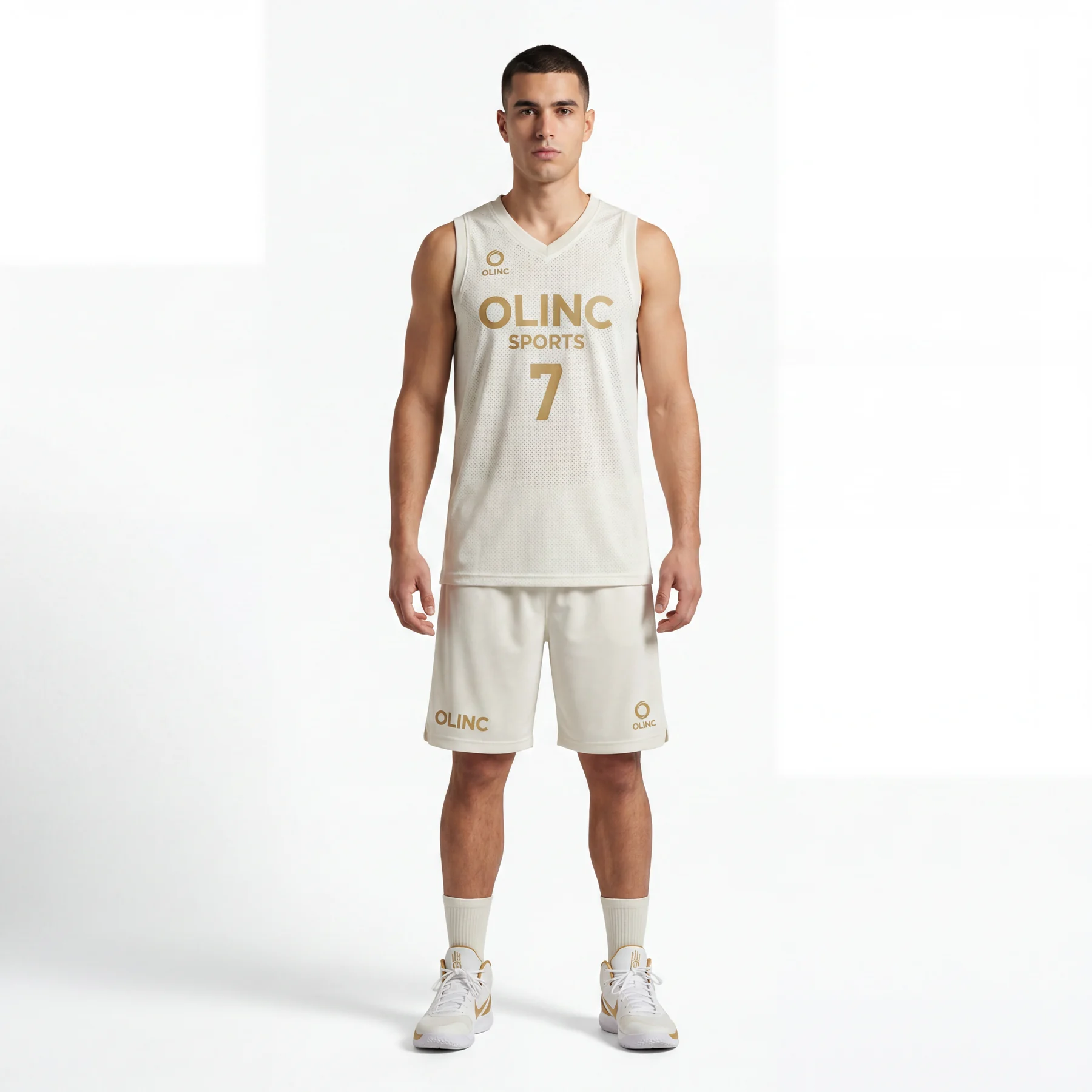
The quote request should include the governing body, country, competition level, first match date, team colours, logos, sponsor files, roster, number list, size method and written answer to any reversible-uniform question. Olinc Sports can then review a custom V-neck basketball jersey and shorts set, a retro basketball set or another specified construction against that brief. Product availability is not certification; the buyer and competition authority retain responsibility for approving the final rules-based design.
Buyer checklist
Turn The Research Into A Quote Brief.
01
Confirm What Counts As Two Sets
Under FIBA rules, obtain written competition guidance before treating one reversible jersey as the required minimum two sets of shirts.
02
Approve Light And Dark Layouts Separately
Check base colours, number contrast, torso or neutral zones, shirt-to-shorts colour relationships and every mark on its final background.
03
Name The Exact Rule And Season
Put the governing body, competition, category, season and applicable rule edition on the technical brief instead of requesting a generic compliant uniform.
04
Time Samples Around Rule Changes
For FIBA play on or after 1 October 2026, verify the new edition before approving colour, sleeve, length and shirt-to-shorts decisions.
Buyer FAQs
Questions To Resolve Before Production.
Does a reversible basketball jersey count as two FIBA sets?
Do not assume it does. The current FIBA rule requires at least two sets of shirts but does not say one reversible garment equals two sets. Ask the relevant federation, league or event organizer and retain its written decision before ordering.
What colours should basketball home and away uniforms use?
Current FIBA rules normally assign a light colour, preferably white, to the first-named or home team and a dark colour to the second-named or visiting team. NFHS uses white home and dark visitor uniforms. Always check the exact competition regulations.
Can NCAA women's basketball jerseys be designed untucked?
The NCAA women's rules change effective in 2025-26 removed the tucked-in requirement because shorter jerseys are being designed for untucked wear. Confirm the current women's rule and intended cut; do not apply that change automatically to men's or other competitions.
When should a buyer apply the FIBA 2026 uniform changes?
The published changes become valid on 1 October 2026. For play on or after that date, confirm the applicable edition and competition regulations before final artwork and sample approval. Before that date, treat the 2026 document as future-effective rather than current.
Research record
Sources Checked On 2026-08-01.
Dates, rules, schedules and technical statements can change. Open the cited first-party source before using a time-sensitive detail for travel, competition or purchasing decisions.
- Official Basketball Rules 2024 — International Basketball Federation (official; accessed 2026-08-01).
- Official Basketball Rules 2026 – Rule Changes — International Basketball Federation (official; accessed 2026-08-01).
- Official Basketball Rules and Interpretations — International Basketball Federation (official; accessed 2026-08-01).
- Basketball Points of Emphasis 2026-27 — National Federation of State High School Associations (official; accessed 2026-08-01).
- NFHS Basketball Uniforms — National Federation of State High School Associations (official; accessed 2026-08-01).
- Men's Basketball Playing Rules — National Collegiate Athletic Association (official; accessed 2026-08-01).
- NCAA Men's Basketball Uniform Guidelines — National Collegiate Athletic Association (official; accessed 2026-08-01).
- 2025-26 and 2026-27 NCAA Women's Basketball Rules Changes — National Collegiate Athletic Association (official; accessed 2026-08-01).