
Researched 2026-09-01 · Cricket match and training kit specification
Should Cricket Match And Training Kits Share One Production Brief?
Keep the crest and colour system connected, but give playing shirts, trousers, training tops and bibs separate style codes, artwork maps, fabric targets and approval samples.
Quick Answer
What Should Cricket Buyers Know?
A cricket match kit and training kit should not share one uncontrolled production brief. Start with the competition, format and ball colour, then obtain the rules that actually govern the team. The current ICC Clothing and Equipment Regulations apply to international matches and distinguish team playing clothing from training clothing; event-specific agreements can override the general ICC document. For ICC One Day International and T20 International playing shirts, the regulations require team uniformity, registered Pantone colours and colours other than white, cream or a light colour likely to affect sighting of the white ball. The same document gives separate controls for Test clothing and says team training bibs must be a distinguishing colour from playing shirts. These international rules are useful specification examples, not automatic requirements for every club or academy. A buyer should create separate style codes and bills of materials for match shirt, match trousers, training top, training trouser or short, and bib. Each file should identify approved artwork, colour references, names and numbers, sponsor status, fabric construction, measurement table, size run, care route, packing and sample owner. Test methods must be named rather than replaced by claims such as match grade: ISO 6330:2021 defines controlled domestic washing and drying procedures, ISO 5077:2007 addresses dimensional change after an appropriate wash-and-dry combination, and ISO 12945-2:2020 addresses fabric pilling, fuzzing and matting using a modified Martindale method.
Cricket research
Name The Competition Before Choosing The Cricket Kit
The first line of a cricket uniform brief should name the competition, governing body, age group, format, season and first required match date. Attach the applicable clothing or playing regulation and identify the person who will approve interpretation. A request for a T20 kit does not tell a factory whether an international, national-board, school, academy or local-league rule controls the artwork.
The ICC Clothing and Equipment Regulations state that their scope covers international matches. They also require event-specific agreements and regulations to be consulted and say those event rules prevail where they conflict with the general document. A club buyer should use the same hierarchy: the league or tournament instruction comes before a generic visual reference, an old jersey or a supplier's assumption.
MCC publishes the Laws that form the framework around cricket, while individual leagues and governing bodies add playing regulations for their formats. The Laws are not a universal artwork placement sheet. Keep the relevant Laws edition in the research file, but obtain the competition's own clothing, sponsor, number and colour instructions before releasing a production proof.
Evidence: International Cricket Council · International Cricket Council · Marylebone Cricket Club
Cricket research
Separate Match Formats Before Mapping Colours And Artwork
Create a format line for every playing style: long-format or multi-day shirt and trouser, one-day shirt and trouser, and T20 shirt and trouser where the buyer needs them. Give each a style code and revision. Do not use a single front-and-back graphic with notes such as make white version too, because piping, base colour, names, numbers, sponsor positions and trim can require different decisions.
The current ICC document illustrates why format matters. Its Test playing-shirt notes describe a plain white or cream base with narrowly controlled piping or trim, while its ODI and T20I playing-shirt notes require colours other than white, cream or a light colour likely to interfere with sighting a white ball. It also requires the team colours and design to be uniform and calls for Member Boards to register Pantone colours. These clauses govern the stated international scope; a factory must not copy them blindly into a local league brief.
Ask the buyer to supply physical or digital colour standards and identify the output process. Record a Pantone reference where the competition or brand workflow uses one, but also approve the result on the selected fabric because sublimation, dyed fabric, rib, mesh and transfer materials can render the same reference differently. Keep match lighting and contrast in the review without claiming that a screen mockup proves the finished colour.
Evidence: International Cricket Council
Cricket research
Give Training Tops And Bibs Their Own Artwork Map
Training garments solve different use cases from playing garments. Define the warm-up top, practice shirt, trouser, short, sweatshirt, tracksuit and bib separately. State whether each item is for official match-day warm-up, ordinary practice, travel or staff use, because the applicable logo and presentation controls may change by competition and venue.
In its international-match scope, the ICC regulations say the team training bib must be a distinguishing colour from the playing shirts. They also say that only Board-issued team training kit may be worn within the ground on match days and official sessions, that training kit is not worn on the field during hours of play, and that the team training kit must be uniform to team members. Outside listed event exceptions, the document gives training design more freedom than playing kit, subject to its stated provisions.
Turn that distinction into two proof sets. The match proof should carry only approved playing marks, numbers and names in their controlled locations. The training proof should identify the bib contrast, garment purpose, crest, sponsor, manufacturer mark and any staff variation. Do not use unused match sponsor space as permission to add another training logo; the buyer or rights holder must approve every mark for the actual use.
Evidence: International Cricket Council
Cricket research
Build Separate Fabric And Construction Targets
A match shirt may prioritize a defined playing silhouette, clean number field, ventilation map and repeatable colour across the squad. A training top may need a different fit, pocket decision, layering allowance, abrasion exposure or laundering frequency. State the fibre content, knit construction, fabric article, mass per unit area, stretch direction, mesh zones, collar and cuff construction, seam type, thread, trims and decoration for each style.
Avoid calling one fabric match grade and another training grade without a measurable specification. Fabric weight alone does not establish pilling, dimensional stability, colour change, seam behaviour or wearer comfort. If the buyer wants to compare two materials, name the test method, specimen state, conditioning, required result and decision owner. A supplier sample, laboratory result and worn trial answer different questions.
ISO 12945-2:2020 specifies a modified Martindale method for determining resistance to pilling, fuzzing and matting. The standard provides a method, not a universal pass mark for cricket jerseys. Buyers should agree the fabric face, test stage, cycle points, assessment scale and acceptance criterion, then keep the approved result with the fabric and garment revision.
Cricket research
Approve Wash Behaviour On The Complete Garment
Test the garment that represents production: base fabric, mesh, rib, transfer, sublimation, embroidery, badges, labels, elastic, thread and seams. A test on unprinted fabric cannot approve number adhesion, embroidery puckering, colour transfer between panels, collar distortion or label legibility. Mark fit-critical measurements before washing and photograph the same locations before and after the agreed cycles.
ISO 6330:2021 provides controlled domestic washing and drying procedures for textile testing and states that a complete test consists of a washing and drying procedure. It includes different reference machines, detergents, ballast and drying routes. The report should identify the selected procedure and number of cycles rather than record only washed or passed.
ISO 5077:2007 covers the determination of dimensional change for fabrics, garments and other textile articles after an appropriate wash-and-dry combination. Define the shirt length, chest, sleeve, collar opening, trouser waist, inseam and other relevant measurement points before testing. Record results by direction and garment component; do not reduce the complete match or training set to one unexplained shrinkage percentage.
Evidence: International Organization for Standardization · International Organization for Standardization
Cricket research
Release Match And Training Samples With Separate Records
Approve one representative sample for every controlled style. The match sample should be reviewed in the intended playing fit with the relevant underlayers and equipment, while the training sample should be reviewed for its own layering and movement use. Record the style code, size, material articles, artwork revision, colours, decoration, measurements, care route and deviations beside each signed decision.
Keep the roster release separate from the garment approval. Player name, number, shirt size, trouser size and quantity should occupy one controlled table with a release date and owner. Training garments may use initials, squad numbers or no personalization, so copying the match roster into the training order can create avoidable errors and unnecessary decorated stock.
At final inspection, reconcile sampled garments to the correct match or training specification. Check style, colour, crest and sponsor revision, names and numbers, measurements, size labels, care labels, workmanship, packing ratio and carton mark. Retain a reference sample or approved evidence set for reorders, and use change control when the competition, sponsor, fabric, decoration, colour or roster format changes.
Cricket research
Send A Cricket Quote Brief That Prices Both Routes
List match and training garments as separate quote lines with quantities, size breakdowns and personalization counts. Provide the competition, format, ball colour, first required date, destination, playing rules, sponsor approvals, colour standards, artwork files, preferred materials, measurement tables, sample sizes, test requirements, care route, packing and delivery basis.
Identify which choices remain open. A factory can compare a sublimated T20 uniform with a retro interlock construction only when the buyer states the performance, appearance and commercial decisions that matter. Ask for option-specific samples or material swatches where necessary; do not expect one price to cover unresolved fabric, decoration, label and testing routes.
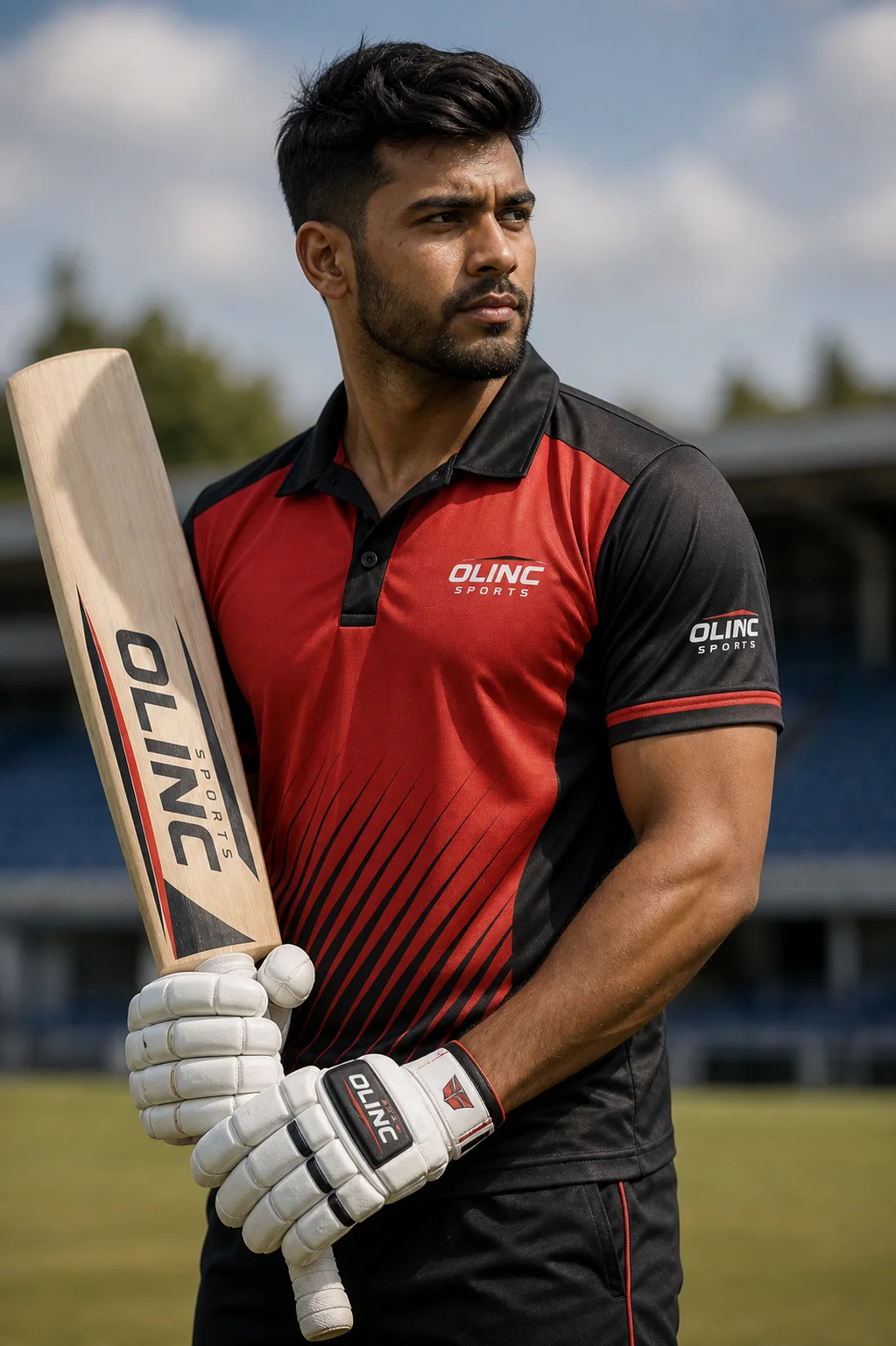
Olinc can review the cricket product brief, build separate match and training specifications and quote the agreed sample-to-bulk route from Sialkot. The buyer remains responsible for supplying the competition and rights-holder requirements that govern the kit. That boundary keeps the quote useful without implying that an ICC international regulation automatically approves a club garment.
Buyer checklist
Turn The Research Into A Quote Brief.
01
Start With The Competition
Name the format, ball colour, governing rules and approval owner before choosing colours or placing artwork.
02
Use Separate Style Codes
Control each match shirt, trouser, training top, short, tracksuit and bib with its own bill of materials and proof.
03
Name The Test Method
Replace match-grade claims with agreed wash, dimensional-change, pilling and garment inspection procedures.
04
Release Two Approval Records
Keep garment approval and player roster release separate so late names, numbers or sizes do not alter the approved kit.
Buyer FAQs
Questions To Resolve Before Production.
Can a cricket club use ICC logo sizes for its local league kit?
Not automatically. The ICC Clothing and Equipment Regulations state an international-match scope, and event-specific rules can prevail. A club must obtain the regulations and approvals for its own league or tournament.
Should a cricket training bib match the playing shirt colour?
The ICC international regulations say a team training bib should be a distinguishing colour from the playing shirts. Other competitions may set their own rule, so record the required contrast in the training-kit brief.
Can one fabric test approve both match and training garments?
Only if the buyer has justified that the materials, construction, decoration and intended acceptance criteria are equivalent. Test and approve the production-representative garment whenever those variables differ.
What should a cricket kit quote include?
Send separate match and training style lines with competition, format, ball colour, quantities, sizes, roster data, artwork, sponsor approval, materials, measurements, samples, tests, packing, destination and required date.
Research record
Sources Checked On 2026-09-01.
Dates, rules, schedules and technical statements can change. Open the cited first-party source before using a time-sensitive detail for travel, competition or purchasing decisions.
- ICC Playing Conditions And Regulations — International Cricket Council (official; accessed 2026-09-01).
- ICC Clothing And Equipment Rules And Regulations — Effective January 2024 — International Cricket Council (primary; accessed 2026-09-01).
- The Laws Of Cricket — 2017 Code, Fourth Edition 2026 — Marylebone Cricket Club (official; accessed 2026-09-01).
- ISO 6330:2021 Textiles — Domestic Washing And Drying Procedures For Textile Testing — International Organization for Standardization (official; accessed 2026-09-01).
- ISO 5077:2007 Textiles — Determination Of Dimensional Change In Washing And Drying — International Organization for Standardization (official; accessed 2026-09-01).
- ISO 12945-2:2020 Textiles — Determination Of Fabric Propensity To Surface Pilling, Fuzzing Or Matting — International Organization for Standardization (official; accessed 2026-09-01).