
Researched 2026-09-22 · Rugby
Rugby Light And Dark Kits: How Should Buyers Approve The Pair?
Two different colour names do not necessarily create two distinguishable rugby kits. The purchasing question is whether the primary and alternate sets work together, on the field and against other teams. This guide uses three official World Rugby resources checked on 22 September 2026 to build a paired sample-approval brief.
Quick Answer
What Should Rugby union Buyers Know?
Brief the primary and alternate rugby kits together, including jerseys, shorts and socks. World Rugby’s kit-colour guidance calls for a dark and a light option and warns that simulated CAD artwork cannot replace physical pre-production samples. Confirm your competition’s approval route, assess the actual sets and retain the approved combinations before releasing bulk production. This is a sourcing workflow, not a claim of World Rugby product endorsement.
Rugby union research
Establish the competition’s approval route first
World Rugby’s July 2024 kit-colour document states that the guidance became policy for World Rugby tournaments on 1 January 2025. It recommends implementation elsewhere where possible as best practice. Do not describe that scope as an identical mandatory approval process for every domestic club.
Before choosing fabrics, ask the organiser who reviews the kit and what must be submitted. Record the competition, season, named contact and deadline for that review. Where the organiser requires physical samples, put that milestone before bulk authorisation rather than treating it as paperwork to finish after shipment.
Evidence: World Rugby
Rugby union research
Purchase a contrasting pair, not two independent designs
Give the designer one brief covering both sets. Identify which elements carry the club identity and which can change between colourways. For example, keep a crest treatment consistent while asking the designer to develop clearly different overall lightness for the two bodies. The actual result still needs assessment; an attractive mock-up is only a proposal.
Keep a complete bill of garments for each option. A second jersey with no corresponding shorts or sock plan can leave the team manager with an incomplete alternative. Show the available combinations explicitly in the approval record, including any pieces intended to be shared. Do not buy extra pieces solely on a guess: ask the reviewer which combinations are needed for the competition.
Assign separate style-colour references even where the pattern and size chart are shared. This allows the quotation, sample comments and packing list to distinguish the sets. Instructions such as home blue and away blue are too imprecise if later messages refer only to the blue sample.
Rugby union research
Use physical samples to resolve the colour decision
World Rugby’s guidance warns that colour-blind simulations of CAD drawings do not represent physical materials under different lighting. It says full kit approval may need to wait for pre-production samples. Its quick greyscale check is a warning tool: similar appearances suggest a likely clash, not a universal certification test.
Build a review appointment around both finished samples arriving together. Ask for the proposed fabric, panel arrangement, decoration and matching accessories, rather than two loose swatches. Label every photograph with the sample revision so a rejected colourway cannot be confused with its replacement. If a component is missing, record the approval as incomplete for that combination.
Evidence: World Rugby
Rugby union research
Check opponents, officials and the playing background
The Watching Rugby guidance discusses clashes with opponents, the pitch and match officials. It recommends assessing kit contrast in the playing setting and lighting, and reviewing officials’ options against both teams. Distinct-looking colours in a changing room can therefore be a poor basis for the final decision.
For the buyer’s review pack, place each proposed set beside the other set and any relevant comparison kits supplied by the organiser. Record the setting, lighting and views used. Include full-body views rather than only a close-up of the crest. Ask the competition reviewer to resolve questionable combinations; the factory should not be expected to choose which opponent’s kit must change.
If the team is ordering a heavily patterned design, include front, back and side views in the submission. Treat those views as documentation of the proposed construction and appearance, not as an automatic pass. Save the reviewer’s actual decision beside the corresponding files.
Evidence: World Rugby
Rugby union research
Turn sample decisions into production instructions
After the paired samples are accepted, write down what was approved on each garment. Include the fabric reference, colour standard or approved physical reference, artwork revision and decoration placement. Identify the shorts and socks that belong to each authorised combination. A sign-off that says colours approved without naming the samples gives the production team too much room to interpret.
If a material or decoration method changes, ask whether the appearance needs another review. This is especially important when the change affects a large visible panel. Keep supplier colour matching and competition contrast approval as separate records: reproducing the requested colour accurately does not itself establish that two teams will be distinguishable.
Request packing labels that use the same colourway names as the approval file. Separate the garment quantities by size and colourway, and check those totals against the team allocation sheet. That is an operational control to help the intended kit reach the intended players, not a promise that extra stock will be unnecessary.
Rugby union research
Give the team manager a usable kit record
World Rugby Passport’s team-manager material reminds buyers that supplier sizing can differ and recommends test kit where appropriate. It also calls for a clothing policy so squad members know when and where the issued apparel should be worn. Colour selection does not replace those practical distribution decisions.
Create a compact handover showing the approved combinations, garment references, size allocations and where to find replacement-order details. Specify who checks match-day kit instructions with the organiser. Keep that handover separate from the supplier’s manufacturing file while linking both to the same approved sample versions.
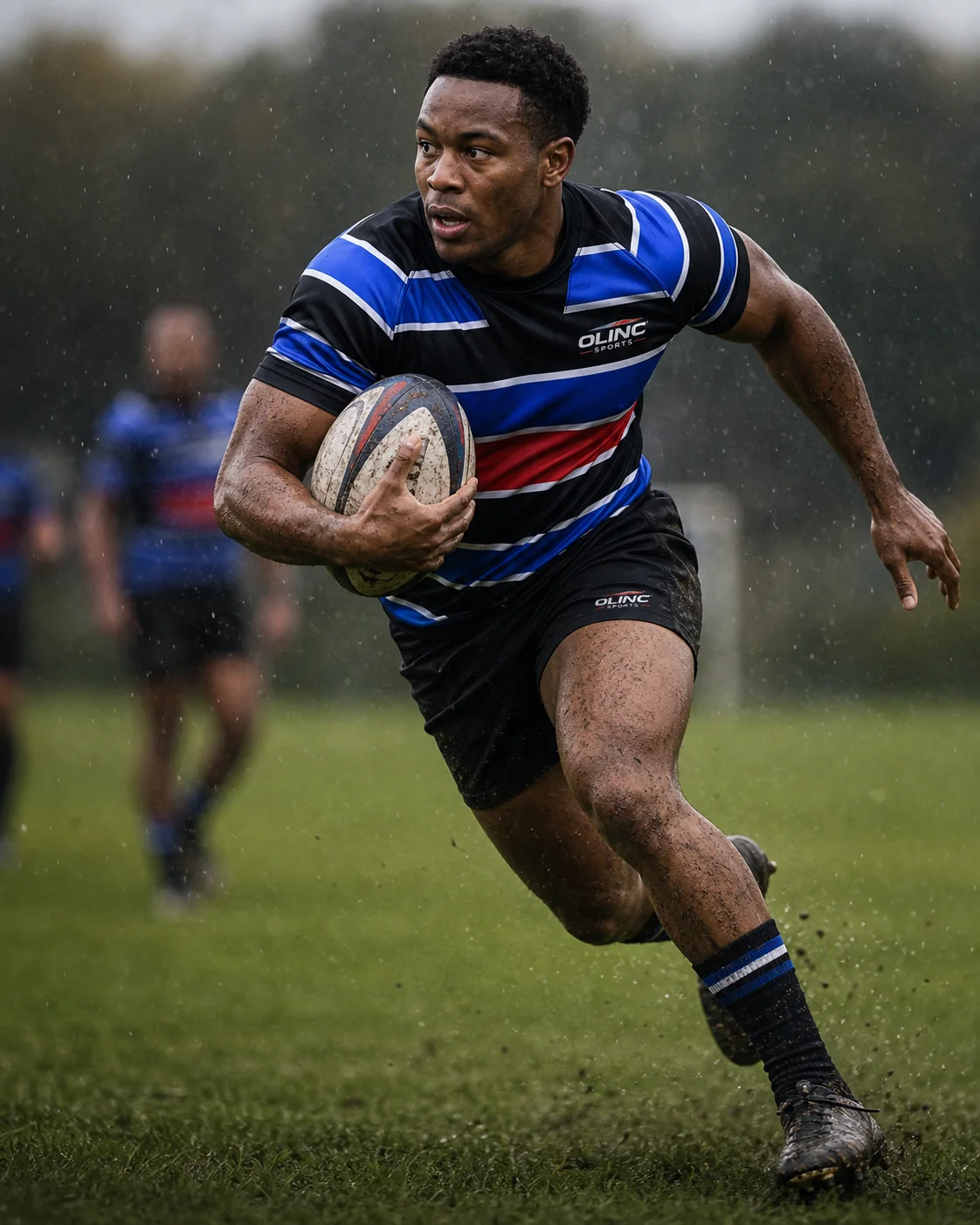
For an Olinc enquiry, send both proposed colourways, the sport and competition, quantities by garment and size, artwork files, sample requirements, packing instructions and destination. Olinc’s rugby programme includes jerseys, shorts and socks; the exact construction and approval timetable must be agreed for the order. Ask for a quote that shows the paired sample work clearly instead of assuming the alternate set is covered by the first sample.
Evidence: World Rugby Passport
Buyer checklist
Turn The Research Into A Quote Brief.
01
Approve both sets together
Identify the complete primary and alternate combinations before the supplier prices or samples them.
02
Do not sign off from CAD alone
Arrange review of the physical pre-production kit through the relevant competition process.
03
Preserve the combination record
Carry the approved colourway and garment references into production, packing and team issue.
Buyer FAQs
Questions To Resolve Before Production.
Are different colour names enough to approve primary and alternate kits?
No. Names identify the order but do not establish useful visual separation. Submit the actual proposed combination through the applicable review process and record the accepted samples.
Does an accurate factory colour match mean the competition has approved the kit?
No. Matching an agreed colour reference and accepting a competition kit combination are separate decisions. Keep evidence of both, with the relevant sample and artwork versions.
What should a replacement order reference?
Use the approved garment style, colourway, fabric and artwork revisions, plus sizes and quantities. Ask the supplier to flag substitutions so the buyer can decide whether appearance or competition review must be repeated.
Research record
Sources Checked On 2026-09-22.
Dates, rules, schedules and technical statements can change. Open the cited first-party source before using a time-sensitive detail for travel, competition or purchasing decisions.
- Colour Blindness and Rugby: Guidelines for Selecting Team Kit Colours — World Rugby (official; accessed 2026-09-22).
- Colour Blindness in Rugby: Watching Rugby — World Rugby (official; accessed 2026-09-22).
- Team Manager Programme: Squad Kit and Apparel — World Rugby Passport (official; accessed 2026-09-22).